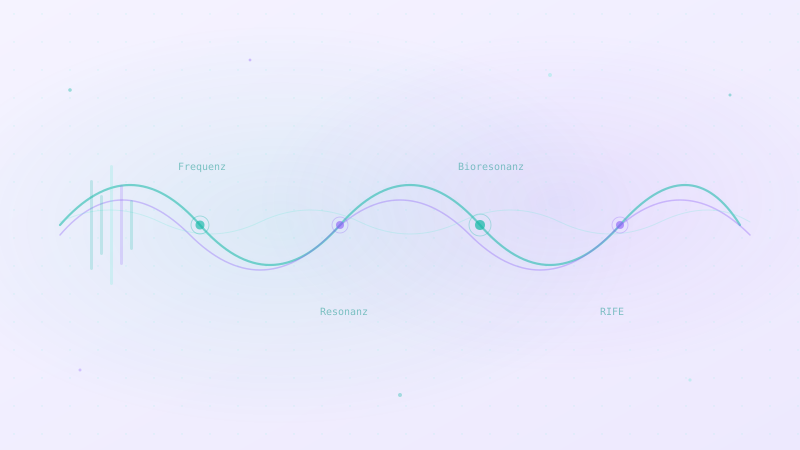
Frequency healing encompasses RIFE therapy, bioresonance, sound healing, and radionics, all based on the principle that targeted frequencies can support the body's natural processes. ResoField combines multiple modalities in one free browser-based platform.
The idea that frequencies can influence health and well-being has deep roots, stretching from ancient sound healing traditions to the electromagnetic experiments of 20th-century inventors. Today, frequency healing is experiencing a resurgence, driven by affordable technology, growing interest in alternative wellness, and a vast body of practitioner experience spanning multiple modalities.
What exactly is a healing frequency? How do the different frequency healing approaches work? And how do you get started without getting lost in the noise?
When we first started exploring frequency therapy in our practice, the biggest challenge was keeping track of which frequencies worked for which conditions. Notebooks and spreadsheets got messy fast, which is part of why I built ResoField.
This guide breaks it all down: the science and theory, the major modalities, the most-referenced frequency lists, and the practical tools available to both beginners and experienced practitioners.
What Is Frequency Healing?
Frequency healing is a broad term encompassing several alternative wellness practices that use specific frequencies (whether electromagnetic, acoustic, or informational) with the aim of supporting the body's natural processes. The central idea is that living organisms operate at certain resonant frequencies, and that applying targeted healing frequencies may help restore balance when those natural patterns are disrupted.
This concept draws on well-established physics principles (resonance, entrainment, wave mechanics) but extends them into territory that mainstream medicine does not currently recognize. While frequency-based approaches have passionate advocates and a long history of practitioner use, most frequency healing modalities lack robust clinical evidence and should be considered complementary practices, not replacements for conventional medical care.
The Theoretical Foundation
Resonance and living systems
Every physical object has a natural resonant frequency, the frequency at which it vibrates most efficiently. This is basic physics, demonstrable with tuning forks, bridges, and wine glasses. The theoretical leap that frequency healing makes is extending this principle to biological systems: cells, tissues, organs, and organisms.
Key historical figures
Several researchers and inventors laid the groundwork for modern frequency healing practices:
Nikola Tesla (1856-1943) believed that understanding the universe required thinking in terms of energy, frequency, and vibration. While his primary contributions were to electrical engineering, his ideas about frequency and resonance have been widely adopted by the alternative wellness community.
Royal Raymond Rife (1888-1971) developed high-powered microscopes and claimed to have identified specific electromagnetic frequencies that could destroy pathogenic microorganisms. His work is the foundation of RIFE frequency therapy, one of the most widely practiced frequency healing modalities today. Rife's claims remain controversial and have not been validated by mainstream science.
Georges Lakhovsky (1869-1942) proposed that living cells are miniature oscillating circuits and that health depends on the proper oscillation of these cellular circuits. He developed the Multi-Wave Oscillator, a device intended to restore cellular frequencies.
Dr. Hans Jenny (1904-1972) founded the field of cymatics, the study of visible sound vibration patterns. His experiments showing how sound frequencies create geometric patterns in physical media provided a compelling visual demonstration of frequency's ability to organize matter. Jenny built on the earlier acoustic research of Ernst Chladni, who first documented how vibrations create visible patterns on rigid surfaces.
Types of Frequency Healing
Frequency healing isn't a single practice. It's a family of related modalities, each with its own approach, tools, and traditions.
RIFE frequency therapy
Named after Royal Raymond Rife, this modality uses specific electromagnetic frequencies targeted at particular conditions. RIFE practitioners reference extensive frequency databases (often containing thousands of entries) and use dedicated hardware devices or software to deliver these frequencies.
How it works: A RIFE device generates precise electromagnetic frequencies, which are delivered to the body through contact electrodes, plasma tubes, or remote transmission. Each frequency targets a specific condition or pathogen based on the principle that matching the organism's resonant frequency will disrupt its function.
Common tools: Spooky2 (a popular open-source hardware/software system), BCX Ultra, TrueRife, and various other purpose-built RIFE devices.
Solfeggio frequency healing and sound therapy
Sound healing uses audible frequencies, delivered through tuning forks, singing bowls, gongs, or audio playback, to promote relaxation, meditation, and well-being. Solfeggio frequency healing is one of the most widely practiced forms, drawing on a specific set of tones with historical roots in Gregorian chant.
How it works: The body is exposed to specific sound frequencies, either through direct acoustic vibration (tuning forks placed on the body, singing bowls) or through listening (headphones, speakers). The proposed mechanism involves acoustic resonance and the phenomenon of brainwave entrainment, where external rhythmic stimuli can influence brainwave patterns.
Common tools: Tuning forks, crystal and Tibetan singing bowls, gongs, binaural beat audio tracks, and solfeggio frequency recordings.
For a deep dive into the individual tones and their associations, see the complete solfeggio frequencies guide.
Bioresonance therapy
Bioresonance is based on the idea that the body emits electromagnetic oscillations, and that unhealthy cells or organs emit altered frequencies. Bioresonance devices claim to read these frequencies, identify disturbances, and send corrective patterns back to the body.
How it works: A bioresonance device connects to the subject via electrodes, reads electromagnetic signals, processes them through the device (which may invert or amplify certain patterns), and returns modified signals to the body. The goal is to reinforce healthy frequency patterns and counteract disruptive ones.
Common tools: BICOM (one of the original bioresonance systems), Healy (a consumer-oriented wearable device), and various other bioresonance platforms.
Radionics
Radionics uses numerical codes called "rates" to represent the energetic signatures of substances, conditions, and states. Practitioners use instruments (hardware or software) to analyze and broadcast these rates, often working at a distance using a "witness" sample.
How it works: The practitioner sets specific radionic rates on an instrument, establishes a connection to the subject through a witness (photograph, hair sample, or other link), and broadcasts corrective rates. The underlying theory proposes that these numerical codes carry informational content that can interact with a subject's energy field.
Common tools: Traditional radionics instruments (SE-5 1000, various artisan-built devices), digital radionics software, and web-based platforms.
Homeopathy and energetic imprints
Homeopathy, while distinct from frequency healing in its historical development, shares conceptual overlap with frequency-based approaches. The preparation of homeopathic remedies through serial dilution and succussion is sometimes described in terms of energetic or frequency imprints.
How it works: Substances are repeatedly diluted and vigorously shaken (succussed), a process that homeopathic theory claims transfers an energetic imprint of the original substance to the water. Digital approaches to homeopathy attempt to encode these imprints as frequency patterns that can be stored and transmitted electronically.
Common tools: Traditional homeopathic pharmacies, remedy makers, and increasingly, digital platforms that work with homeopathic remedy frequencies.
Hz Values in Frequency Healing
One of the first things newcomers to frequency healing encounter is the sheer number of specific hz frequency healing values referenced across different modalities. Understanding what these numbers mean, and where they come from, helps you navigate the field with more confidence.
Hz (hertz) is simply a unit measuring cycles per second. A frequency of 528 Hz oscillates 528 times per second. In frequency healing, hz values appear in three broad ranges:
- Sub-audio range (below 20 Hz): Frequencies like the Schumann resonance (7.83 Hz) fall here. These can't be heard but may be delivered through vibration, pulsed electromagnetic fields, or other methods.
- Audio range (20 Hz to 20,000 Hz): The solfeggio frequencies, binaural beats, and most sound healing tones sit in this range. They can be heard and delivered through speakers or headphones.
- Ultrasonic and above (above 20 kHz): RIFE hardware operates into the MHz range. These frequencies require dedicated equipment to generate.
The practical implication is that hz frequency healing tools vary significantly in what they can deliver. An app playing 528 Hz through headphones is doing something different from a hardware RIFE generator running a MHz-range protocol. Both are used by practitioners, but they're distinct approaches.
Solfeggio frequencies
The solfeggio frequencies are perhaps the most widely known healing frequency set, popularized through their connection to ancient musical scales:
| Frequency | Traditional association |
|---|---|
| 174 Hz | Pain relief, sense of security |
| 285 Hz | Tissue healing, restoring energy fields |
| 396 Hz | Liberating guilt and fear |
| 417 Hz | Facilitating change, clearing negativity |
| 528 Hz | Transformation, DNA repair (sometimes called the "love frequency") |
| 639 Hz | Harmonizing relationships, reconnection |
| 741 Hz | Awakening intuition, self-expression |
| 852 Hz | Returning to spiritual order |
| 963 Hz | Connection to higher consciousness |
These associations are based on practitioner tradition rather than scientific research. However, there is growing academic interest in the effects of specific sound frequencies on stress and relaxation responses. A 2018 study published in the Journal of Addiction Research & Therapy examined the effects of 528 Hz sound waves on cell cultures, contributing to the growing body of preliminary research in this area.
Schumann resonance
The Schumann resonance of 7.83 Hz is the fundamental electromagnetic frequency of the Earth's atmosphere, generated by lightning activity within the cavity between the Earth's surface and the ionosphere. It's a measurable geophysical phenomenon and is sometimes referred to as the "Earth's heartbeat."
In frequency healing circles, the Schumann resonance is considered a grounding frequency. Some practitioners and researchers hypothesize that exposure to this frequency may support circadian rhythms and general well-being, though clinical evidence remains limited.
RIFE frequency databases
RIFE frequencies are typically organized by condition in large databases. Unlike the solfeggio set, RIFE frequency lists contain thousands of entries. For example, the Consolidated Annotated Frequency List (CAFL), one of the most widely referenced RIFE databases, contains frequencies for hundreds of conditions, with each entry often listing multiple frequencies to be applied in sequence.
RIFE frequencies range from a few hertz to several megahertz and are far more specific and numerous than other healing frequency lists. They're generally used with dedicated RIFE hardware or software rather than simple audio playback.
Frequency Sound Healing vs Quantum Delivery
Frequency sound healing uses audible tones that the body receives through the ears and, in some approaches, through physical vibration in the body's tissues. It's the oldest and most accessible form of frequency therapy. Ancient traditions using drums, chanting, and singing bowls operated on these same principles long before anyone measured frequencies in hertz.
Modern frequency sound healing typically delivers tones through headphones or speakers, sometimes pairing them with binaural beats (slightly different frequencies in each ear) to encourage specific brainwave states. The mechanism is primarily acoustic: sound waves interact with the nervous system and may shift physiological states through the auditory pathway.
Quantum or scalar delivery modes work differently. Rather than transmitting audible sound, these approaches encode frequency information into subtle field effects, a concept that draws more heavily on theoretical physics and has less conventional research support. ResoField supports both modes, allowing practitioners to work with frequency sound healing for accessible, well-understood sessions and quantum modes for those who want to explore non-acoustic delivery.
The choice between them often comes down to personal experience and the preferences of the people you're working with. Beginners usually start with frequency sound healing simply because it's familiar and requires nothing beyond a good pair of headphones.
What Does a Frequency Healing Session Look Like?
The practical experience of a frequency healing session varies dramatically depending on the modality:
Sound healing session: You might lie comfortably while a practitioner places tuning forks on or near your body, plays singing bowls around you, or guides you through a meditation with specific audio frequencies playing through speakers. Sessions typically last 30 to 60 minutes and are deeply relaxing for most people.
RIFE frequency session: You would connect to a RIFE device via handheld electrodes, foot plates, or sit near a plasma tube while the device runs through a programmed sequence of frequencies. Sessions can range from 15 minutes to several hours depending on the protocol.
Bioresonance session: Electrodes are attached to your hands, feet, or specific body areas. The device reads and processes signals, then sends modified patterns back. A typical session lasts 30 to 60 minutes.
Radionics session: The practitioner works with your witness sample (often a photograph) and their instrument. You may or may not be physically present. One of radionics' distinctive claims is that it can work at a distance.
Devices and Tools: Hardware vs Software
The frequency healing landscape has shifted significantly toward digital tools in recent years.
Hardware devices
Dedicated hardware devices remain the standard for many modalities:
- Spooky2: An open-source RIFE system with a large community, offering multiple delivery methods (contact, remote, plasma). Starting cost around $200-$500 for basic kits.
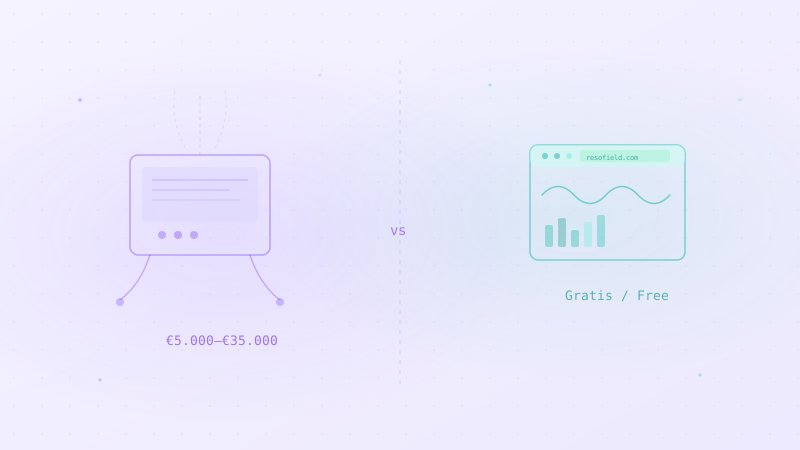
- Healy: A consumer wearable bioresonance device. Priced at $500-$4,000+ depending on the model and program packages.
- BICOM: A professional bioresonance system used primarily in clinical settings. These are professional-grade instruments with prices to match.
- Singing bowls and tuning forks: Physical acoustic instruments ranging from $30 for a basic tuning fork to $500+ for quality crystal singing bowls.
Software and digital platforms
An increasing number of practitioners are moving to software-based tools that offer advantages in cost, portability, and versatility:
- Frequency generator apps: Simple apps that generate specific audio frequencies through your device's speaker or headphones
- RIFE software: Programs that store frequency databases and can run programmed sequences through connected hardware
- Multi-modality platforms: Platforms like ResoField that combine multiple frequency-based modalities (including RIFE frequencies, radionics, bioresonance protocols, and homeopathic frequencies) in a single interface
The advantage of a multi-modality platform is practical: rather than owning separate devices for different modalities, practitioners can explore and work across multiple approaches from one place.
Getting Started with Frequency Healing
For beginners
If you're new to frequency healing, here's a practical starting path:
- Start with sound frequencies: Solfeggio frequencies and binaural beats are the most accessible entry point. You need nothing more than a pair of headphones and a streaming service. Listen to 528 Hz or 432 Hz music during meditation or relaxation and observe how it affects your experience.
- Explore the theory: Read about the different modalities to understand their distinct approaches. What resonates with you conceptually? Your interest and engagement matter for sustained practice.
- Try a guided session: Many sound healers, bioresonance practitioners, and RIFE therapists offer introductory sessions. Experiencing a modality firsthand is worth more than hours of reading.
- Experiment with free tools: Before investing in hardware, explore free software platforms that let you work with different frequency modalities. ResoField offers free access to multiple frequency healing tools, which can help you discover which approaches you want to explore further.
- Keep a journal: Track your sessions: what frequencies you used, duration, and any observations. Patterns emerge over time that help you refine your practice.
For practitioners
If you're already working in an alternative wellness modality and want to add frequency-based tools:
- Identify the modality that complements your existing practice: A homeopath might explore digital remedy frequencies. A massage therapist might add sound healing. A naturopath might investigate RIFE or bioresonance.
- Choose tools that match your commitment level: Start with software to explore, then invest in hardware if you find the modality effective in your practice.
- Get proper training: Each modality has its own body of knowledge. Organizations, courses, and mentorships exist for RIFE, radionics, bioresonance, and sound healing. Learn from experienced practitioners.
- Integrate thoughtfully: Frequency-based tools work best as part of a holistic approach, not as standalone solutions. Consider how they fit into your overall practice methodology.
A Note on Expectations
Frequency healing is a field rich in practitioner experience and historical tradition but limited in clinical validation. Approach it with open-minded curiosity rather than absolute expectations. What works profoundly for one person may not for another. The most successful practitioners tend to be those who combine genuine knowledge of their modality with honest self-assessment and appropriate humility about what frequency-based approaches can and cannot do.
Frequency healing practices are not intended to diagnose, treat, cure, or prevent any disease. They should be considered complementary approaches and should not replace professional medical advice, diagnosis, or treatment. Always consult a qualified healthcare provider for medical concerns.
References
- Journal of Addiction Research & Therapy - 528 Hz study - Research on the effects of 528 Hz sound waves on cell cultures
- Nikola Tesla - Wikipedia - Background on Tesla's contributions to electromagnetic research
- Royal Rife - Wikipedia - History of Royal Raymond Rife and the origins of RIFE frequency therapy
- Ernst Chladni - Wikipedia - Pioneer of acoustics and early cymatics research
- Hans Jenny (cymatics) - Wikipedia - Founder of the modern field of cymatics
Frequently Asked Questions
What is frequency healing and how does it work?
Frequency healing is a collective term for alternative wellness practices that use specific frequencies (electromagnetic, acoustic, or informational) to support the body's natural processes. The underlying theory proposes that living organisms have natural resonant frequencies, and that applying targeted healing frequencies can help restore balance when these patterns are disrupted. Different modalities deliver frequencies in different ways: RIFE therapy uses electromagnetic signals, sound healing uses audible tones, bioresonance reads and modifies the body's own signals, and radionics uses numerical codes called rates. While these practices have long traditions and many practitioner reports of positive results, they are not yet supported by robust clinical evidence.
What are the best healing frequencies to start with?
For beginners, the solfeggio frequencies are the most accessible starting point. The 528 Hz frequency (often called the "love frequency" or "miracle tone") and 432 Hz (considered a natural tuning frequency) are particularly popular for relaxation and meditation. The Schumann resonance of 7.83 Hz is widely used for grounding. If you're exploring sound healing, start with these well-known frequencies through simple audio playback before moving into more specialized modalities like RIFE or bioresonance, which require specific equipment and deeper knowledge.
Is there a healing frequency list I can reference?
Several widely used frequency lists exist. The solfeggio scale (174, 285, 396, 417, 528, 639, 741, 852, and 963 Hz) is the most commonly referenced set for sound-based healing. For RIFE therapy, the Consolidated Annotated Frequency List (CAFL) is the most extensive resource, containing thousands of frequency entries organized by condition. Various bioresonance systems also maintain proprietary frequency databases. Keep in mind that these lists come from practitioner experience and tradition rather than controlled clinical research, and new frequencies continue to be explored and shared within the community.
Do I need expensive equipment for frequency healing?
Not at all. You can begin exploring frequency healing with nothing more than a smartphone and headphones by listening to solfeggio frequency recordings or binaural beat tracks, many of which are available for free on streaming platforms. Basic tuning forks cost $15 to $30. When you're ready to explore more specialized modalities, software platforms offer access to RIFE frequencies, radionics, and other tools at a fraction of the cost of dedicated hardware. Hardware devices become worthwhile investments for committed practitioners, but they're not necessary to begin.
Is frequency healing scientifically proven?
Most frequency healing modalities lack the kind of large-scale, peer-reviewed clinical trials that mainstream medicine requires for validation. There is some scientific research supporting specific aspects, including studies on music therapy and its effects on stress, pain perception, and anxiety; research on ultrasound therapy in physical rehabilitation; and growing interest in the biological effects of electromagnetic frequencies. However, the specific claims made by many frequency healing modalities (such as particular frequencies targeting particular conditions) remain unproven by conventional scientific standards. It's best to approach frequency healing as a complementary practice alongside, not instead of, conventional medical care.
Are there frequency healing apps I can use on my phone?
Yes, there are numerous frequency healing apps available. Simple frequency generator apps let you play specific tones through your phone's speaker or headphones. More sophisticated apps offer guided sound healing sessions, binaural beat programs, or structured frequency protocols. For practitioners who want to work with multiple modalities, web-based platforms like ResoField provide access to RIFE frequencies, radionics tools, bioresonance protocols, and more from any device with a browser. When choosing an app or platform, look for transparent information about what frequencies are included, how they're delivered, and what the tool can realistically do.
Marvin Carter
Marvin Carter is a software developer and self-taught homeopathy practitioner who founded ResoField in 2025. Together with his wife, who runs a resonance therapy practice, he has 7+ years of hands-on experience and 100+ clients treated. With personal experience using devices like QEST4, Sulis, and Mora, he bridges the gap between IT and holistic health.