Modern rife machine software delivers the same frequency therapy as hardware generators, without the cost or complexity. ResoField is a free browser-based rife platform that works on any device with no downloads required.
For decades, rife machines have existed as specialized hardware devices: bulky boxes with cables, electrodes, and price tags that put them out of reach for most people. But in 2026, something has changed. Modern rife machine software now delivers the same frequency therapy experience through a smartphone or computer, often for free.
If you've been researching rife frequency therapy but felt overwhelmed by hardware costs and technical complexity, this guide will show you how software-based alternatives work, what they can do, and how to get started without spending hundreds or thousands of dollars.
Before building ResoField, I spent months using Spooky2's software with their generator hardware. The software is powerful but steep to learn, and the hardware setup took over half our treatment room. That experience directly shaped how I designed the frequency therapy features in ResoField.
What Is a Rife Machine?
A rife machine is a device that generates specific electromagnetic frequencies, originally developed by Royal Raymond Rife in the 1930s. Rife, an American inventor and microbiologist, believed that every microorganism and cell has a unique resonant frequency, a concept he called the "mortal oscillatory rate." His theory proposed that by directing specific frequencies at targeted organisms, it was possible to disrupt their function without harming surrounding tissue.
The original Royal Rife machine was far more than a frequency generator. Rife spent years building increasingly powerful microscopes (instruments capable of magnification that wasn't matched by conventional optics of the era) and used them to observe microorganisms while testing the effects of different frequencies. His frequency generators grew increasingly sophisticated through the 1930s and 1940s. After his work fell into obscurity following legal and institutional setbacks, a small community of researchers and enthusiasts preserved his notes and frequency lists. That community grew substantially with the arrival of the internet, eventually producing the open-source databases and affordable hardware systems available today.
While the original claims of Royal Rife remain controversial and have not been validated by mainstream clinical research, the underlying concept of frequency therapy has persisted and evolved. Today, thousands of practitioners and individuals worldwide use rife-inspired frequency generators as a complementary wellness tool.
It is important to note that rife therapy is considered a complementary approach and should not be used as a replacement for conventional medical treatment. Always consult a qualified healthcare professional for medical concerns.
How Rife Frequency Therapy Works
The basic principle behind rife frequency therapy is cellular resonance. Every physical structure (from a wine glass to a bridge to a biological cell) has a natural frequency at which it vibrates. When an external frequency matches that natural resonance, the amplitude of vibration increases dramatically. This is the same phenomenon that allows an opera singer to shatter a glass with their voice.
Rife frequency therapy applies this concept to wellness. Practitioners use frequency generators to output specific frequencies (measured in hertz), targeting particular conditions or wellness goals. A typical rife session involves:
- Selecting a frequency program: curated sets of frequencies associated with specific wellness goals
- Delivering the frequencies: traditionally through contact electrodes, plasma tubes, or remote modes
- Running the session: programs typically last between 5 and 60 minutes, depending on the protocol
Over the decades, researchers and practitioners have compiled extensive frequency databases. The CAFL (Consolidated Annotated Frequency List) alone contains thousands of frequency sets, and many devices include their own proprietary libraries.
Rife Machine Benefits
Practitioners who use rife machines cite several potential benefits, though it's important to note that these are based largely on community experience and self-reporting rather than controlled clinical studies.
The most commonly reported rife machine benefits include general wellness support and relaxation during sessions. Many practitioners use rife frequencies as part of broader wellness protocols alongside other complementary approaches. Some report subjective improvements in energy and sleep quality with consistent use over weeks or months.
The more practical benefits are less ambiguous. Rife frequency therapy gives practitioners access to thousands of specific frequency programs organized by wellness category, a level of specificity that simple relaxation tools don't offer. Sessions are non-invasive and can be run at home. Software-based rife tools have made this accessible to people who previously couldn't afford dedicated hardware.
As with all frequency healing modalities, rife machine benefits should be understood in context: these are complementary wellness tools, not proven medical treatments. The experience varies considerably between individuals.
Hardware Rife Machines: What's Available
The hardware rife machine market ranges from entry-level consumer devices to professional-grade systems. Here's a look at the most well-known options:
Spooky2
Spooky2 is the most popular hardware rife machine system available today. The basic Spooky2 XM generator starts around $100-$150, but a complete setup with accessories, plasma tube, and remote kit can easily exceed $500-$1,000. Spooky2 runs on Windows-only software that controls the hardware generators. The system is powerful but has a steep learning curve: the software interface can be overwhelming for newcomers, and setup requires connecting hardware, installing drivers, and configuring generator settings.
For a detailed comparison of Spooky2 against software alternatives, see Spooky2 vs ResoField.
GB-4000
The GB-4000 is a mid-range rife frequency generator priced around $1,800-$2,200 for a basic unit. Adding the SR-4 amplifier and plasma tube brings the total closer to $3,100 or more. It offers multiple output modes and is well-regarded in the rife community for build quality, but it requires significant technical knowledge to operate effectively.
TrueRife
TrueRife systems occupy the premium end of the consumer market, with complete systems ranging from $2,500 to over $5,000. These are well-built machines with dedicated software, but the cost puts them beyond reach for many interested users.
Common limitations of hardware
Across all hardware rife machines, several challenges are consistent:
- Cost barrier: even entry-level setups require a meaningful investment
- Platform restrictions: most control software runs on Windows only
- Portability: generators, cables, and accessories are not easily portable
- Technical complexity: setup, driver installation, and configuration can deter beginners
- Maintenance: hardware components can fail, require updates, or need replacement
The Software Revolution: Rife Machine Software Goes Digital
The concept behind a rife machine is fundamentally about generating precise frequencies. And in 2026, every smartphone, tablet, and laptop contains hardware fully capable of generating audio-range frequencies with high accuracy.
This realization has driven a wave of rife machine software and rife machine apps that deliver frequency therapy without any dedicated hardware. Instead of a separate generator box, these applications use the device's built-in speakers, headphones, or digital output to deliver frequencies directly.
Modern rife machine software typically offers:
- Frequency libraries: pre-built programs drawn from databases like the CAFL and ETDFL
- Custom frequency input: the ability to enter specific frequencies manually
- Multiple delivery modes: audio output through speakers or headphones, and in some cases scalar or quantum modes
- Session management: timers, program sequencing, and session history
- Cross-platform access: availability on iOS, Android, and web browsers
The result is a free rife frequency generator that fits in your pocket and requires zero setup beyond opening an app.
ResoField as a Rife Machine App
ResoField works as a rife machine app that runs entirely in your browser, with no downloads, no hardware, and no Windows requirement. The built-in frequency library draws from the CAFL and ETDFL databases, giving you access to thousands of rife frequency programs organized by category.
What separates ResoField from simple tone generators is the delivery architecture. Rather than just playing audio, the platform supports quantum delivery modes that encode frequency information differently, which appeals to practitioners who have found audio-only approaches limiting. You can switch between sound and quantum delivery depending on the session and the person you're working with.
ResoField also supports multiple modalities beyond rife frequencies, including radionics, bioresonance protocols, and homeopathic frequencies, all within the same interface. For practitioners exploring different approaches, this removes the need for multiple separate tools.
The core functionality is free. For those running a professional practice, subscription tiers unlock additional libraries and session management features.
Rife Machine Software vs Hardware: A Comparison
| Feature | Hardware Rife Machine | Rife Machine Software |
|---|---|---|
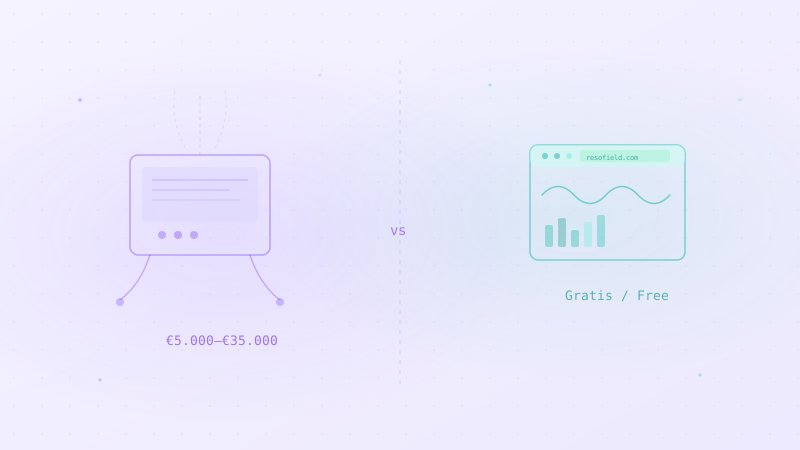
| Cost | $100 - $3,100+ | Free - $50/year |
| Portability | Limited (generator + accessories) | Fully portable (phone/tablet) |
| Setup time | 30-60 minutes (drivers, calibration) | Immediate |
| Platform | Windows only (most devices) | iOS, Android, Web |
| Frequency range | 1 Hz - 20+ MHz | 1 Hz - 22,000 Hz (audio) |
| Output modes | Contact, plasma, remote | Audio, scalar/quantum |
| Frequency libraries | Varies by device | Comprehensive (CAFL, ETDFL) |
| Ease of use | Moderate to advanced | Beginner-friendly |
| Updates | Manual firmware/software | Automatic |
| Maintenance | Hardware repairs needed | None |
The main technical difference is frequency range. Hardware generators can produce frequencies well above the audible spectrum (into the MHz range), while software-based tools are typically limited to audio frequencies (up to ~22 kHz). However, many rife protocols use audio-range frequencies or apply them through harmonic relationships, which software handles well. For more on how frequency therapy works in practice, see resources at rifetherapies.com.
For practitioners and individuals looking for a low-cost, accessible entry point into rife frequency therapy, software-based options have become a compelling alternative to expensive hardware systems.
Getting Started with Software-Based Rife Therapy
If you're interested in exploring rife frequency therapy through software, here's a practical starting path:
- Choose a rife frequency app: look for an application with a comprehensive frequency library (CAFL/ETDFL coverage), intuitive interface, and no mandatory hardware purchases. ResoField, for example, offers a free platform with a built-in RIFE frequency library, custom frequency input, and both sound and quantum delivery modes.
- Start with basic programs: begin with general wellness frequency sets rather than jumping into complex protocols. Run shorter sessions (10-20 minutes) to see how you respond.
- Use quality audio output: if using audio-mode delivery, good headphones or speakers improve the experience. Bone conduction headphones are popular in the rife community for direct frequency delivery.
- Keep a session journal: track which programs you run, for how long, and any subjective observations. This helps you identify which frequencies and protocols feel most relevant for your goals.
- Research the frequencies: understand what frequency sets you're using and why. The CAFL database is well-documented, and many community forums discuss specific protocols in detail.
- Be patient and consistent: frequency therapy practitioners generally recommend consistent sessions over weeks rather than expecting immediate results from a single session.
- Consult professionals when needed: rife frequency therapy is a complementary tool. It should be used alongside, not instead of, professional medical advice and treatment.
The Accessibility Advantage
Perhaps the most significant impact of rife machine software is accessibility. A decade ago, exploring rife frequency therapy required a minimum investment of several hundred dollars and a Windows computer. Today, anyone with a smartphone can access a free rife frequency generator and begin exploring frequency therapy within minutes.
This shift has opened the door for more people to explore frequency-based wellness practices, for practitioners to offer frequency protocols without requiring clients to purchase expensive hardware, and for researchers to study the effects of frequency therapy with larger, more diverse populations.
Whether you're a curious newcomer, an experienced practitioner looking for a portable solution, or someone who has been priced out of hardware rife machines, software-based alternatives offer a practical and accessible path forward.
References
- Royal Rife - Wikipedia
- Spooky2 - Official website
- Consolidated Annotated Frequency List (CAFL)
- Rife Therapies - Frequency generator information
Frequently Asked Questions
Is rife machine software as effective as hardware rife machines?
Software-based rife tools generate the same audio-range frequencies as hardware devices. The primary difference is that hardware generators can produce frequencies above the audible range (into the MHz spectrum), while software is typically limited to around 22 kHz. For the many rife protocols that use audio-range frequencies, software delivers equivalent output. Effectiveness of rife therapy in general has not been conclusively established by clinical research, so comparisons should be considered in that context.
Are there truly free rife frequency generator options?
Yes. Several rife frequency apps offer free access to core features, including frequency libraries and basic session tools. ResoField provides free access to its RIFE frequency library, custom frequency input, and multiple delivery modes. Some apps use a freemium model with premium features behind a subscription, so it's worth checking what's included in the free tier.
Can rife machine software replace conventional medical treatment?
No. Rife frequency therapy is considered a complementary approach and should never be used as a substitute for conventional medical treatment. Always consult a qualified healthcare professional for any medical condition. Frequency therapy may be used alongside professional medical care as part of a broader wellness routine, but it is not a proven treatment for any specific disease.
What equipment do I need to use a rife frequency app?
At minimum, you need a smartphone, tablet, or computer. For audio-mode delivery, headphones or quality speakers are recommended. No additional hardware, generators, or accessories are required. Some users prefer bone conduction headphones for a more direct frequency delivery experience, but standard headphones work as well.
How does rife machine software compare to Spooky2?
Spooky2 is a hardware-software hybrid system: the software is free, but it requires Spooky2 generator hardware (starting around $100-$150) and runs on Windows only. Standalone rife machine software works independently on any device without additional hardware. Spooky2 offers more output modes (contact, remote, plasma, PEMF) and a wider frequency range, while software-only solutions offer greater portability, cross-platform support, and lower cost of entry.
What frequencies are included in rife machine software?
Most rife frequency apps include databases such as the CAFL (Consolidated Annotated Frequency List) and ETDFL, which contain thousands of frequency programs compiled by the rife community over decades. These cover a wide range of wellness categories. Good rife machine software also allows you to input custom frequencies manually, giving you flexibility beyond the pre-built libraries.
Marvin Carter
Marvin Carter is a software developer and self-taught homeopathy practitioner who founded ResoField in 2025. Together with his wife, who runs a resonance therapy practice, he has 7+ years of hands-on experience and 100+ clients treated. With personal experience using devices like QEST4, Sulis, and Mora, he bridges the gap between IT and holistic health.